About Us
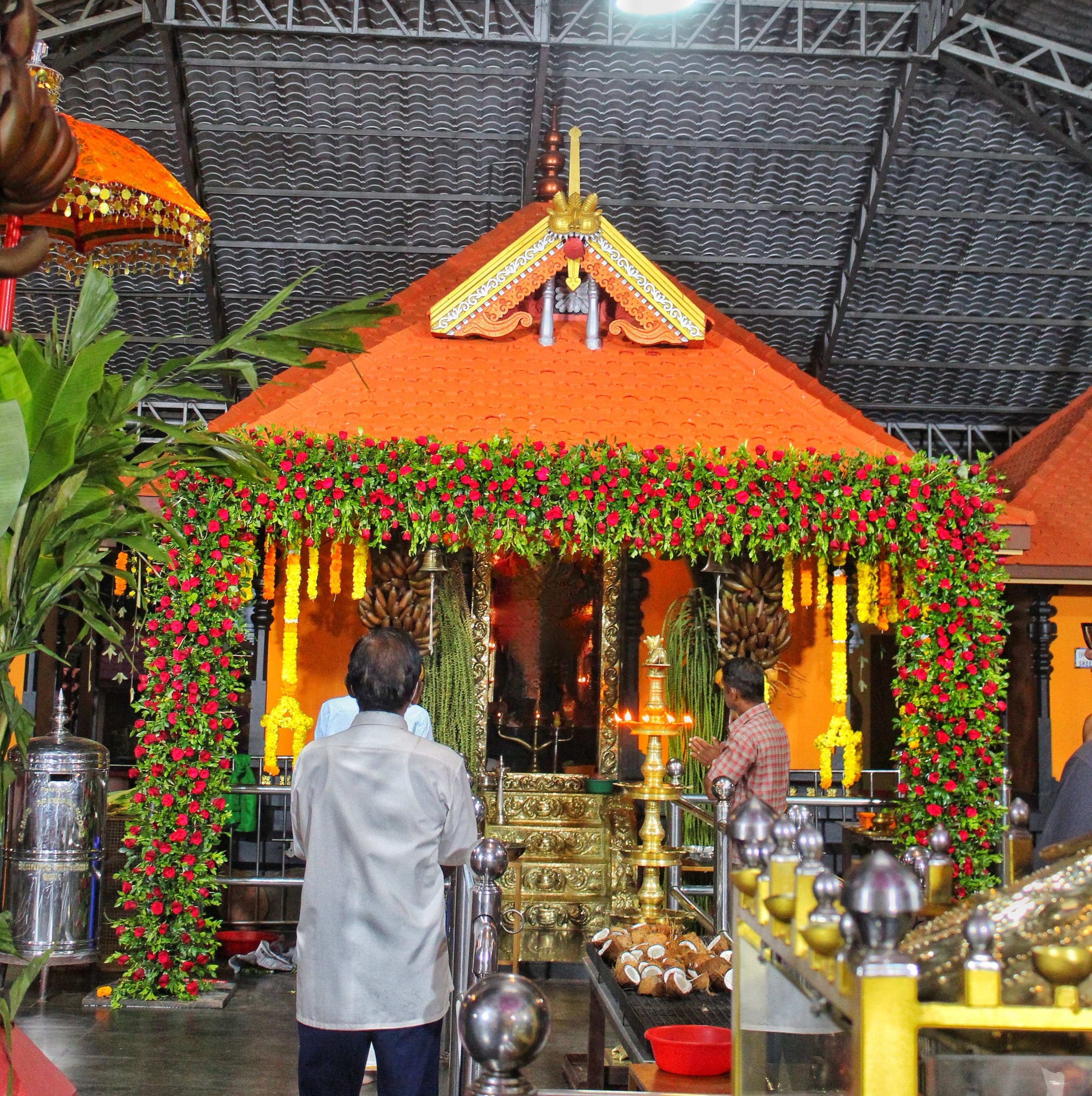
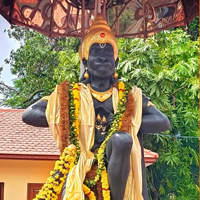
SREE HANUMAN SWAMY TEMPLE, PANGODE
The history of Temples at Thiruvananthapuram owned by the Madras Regiment and managed by the Madras Regimental Centre is associated with the history of Venad (later Travancore) and its Army.
The jurisdiction of Venad extended over a small tract lying between Thiruvananthapuram and Kollam (Quilon). The political scene of Venad underwent remarkable changes when Anizham Tirunal Veera Bala Marthaanda Varma assumed as Trippaappoor Mooppan and later when he ascended the throne of Venad in 1729 A.D.
After the unification of the state he took a momentous step of Trippati Daaanam (dedication of the kingdom) to his tutelary deity Sree Padmanabhaswamy of Thiruvananthapuram on 5th Makaram 925 M.E. corresponding to 03 Jan 1750 A.D. Thereafter he and his successors ruled Travancore as Padmanaabha-daasas or servants of Sree Padmanabhaswaamy. By the Trippati Daanam concept, the State belonged to the Lord and it helped in the long run to pave political stability in the State.
In 1757, the Travancore Army consisted of 30,000 Nairs of which 10,000 regular and 20,000 were irregular infantry. Consequent to the famous insurrection within the army in 1809, the whole military force of Travancore was disbanded with the exception of the First Nair Battalion and few mounted troops which were retained for purposes of State and Military ceremonies. A Second Battalion of Nair troops raised the strength of the Army during the reign of Raani Gouri Paarvathi Bayi (1815-29) besides forming a new detachment of Artillery. Though the Nair battalion came into existence from 1809 A.D. the designation of the Army was changed to Nair Brigade only in 1830 A.D. The Nair Brigade took over the barracks at the Cantonment (Palayam, Thiruvananthapuram) previously occupied by the British troops. They continued to stay there till 1935 when the Nair Brigade was renamed as State Forces and their Headquarters shifted to the present site at Pangode. All the officers and jawans who gloriously served the State Forces till 1956 were closely associated with the temples managed by them at Pazhavangadi and at Pangode.
The State forces had their garrison at the old Cantonment area adjacent to the present Legislative Assembly complex. Consequent to the shifting of the garrison from Cantonment to Pangode in 1935, the State Forces felt the need of establishing a place of worship for their troops at the new Cantonment area and a Temple was established at Pangode.
LEGEND
There are five main idols - Lord Hanuman Swamy, Lord Siva, Lord Vishnu, Lord Ganapathy and Nagaraja in the temple complex. Of these the history of Lord Siva traces back to a period of 175 years. In one of the annual exercises around 1836 of the Nair Brigade at Aaruvaamozhi (Aramboli, presently in Kanyakumari district) they found an idol of Lord Siva under a peepul tree. The troops used to worship this idol whenever they were on duty there. By 1840 AD, they took this idol to the garrison at Cantonment. In 1940 this idol of Lord Siva was shifted to Pangode by the side of the then idol of Lord Vishnu, which was installed around a decade earlier. Astrological predictions and local people had opposed in shiftintg the idol of Lord Hanuman Swamy from the Cantonment to Pangode. Therefore the State Forces kept a picture of Lord Hanumanswamy at Pangode having similar features as that of Cantonment by the side of the Lord Siva idol. Later an idol of Lord Hanuman Swamy worshipped at the Fort Area by the troops of Nair Brigade was brought to Pangode and installed. The antiquity of this idol is not known. In the south western side of Pangode military area, there was an ancient idol of Lord Krishna which was in a state of neglect. Since this idol had some damages it was removed and immersed in the sea in 1986 as per the thanthric advice after transferring the powers to the idol of Lord Vishnu. In 1988 the idol of Lord Ganapathy and Nagaas were also installed besides changing the peetham of Lord Siva.
After the establishment of War Memorial adjacent to Sree Hanuman Swamy Temple complex, the Lord expressed through a Deva Prasna to shift the idols to a suitable place. Subsequently, in 2001, a plot close to Station Workshop EME facing the Thirumala - PTP Nagar road was allotted by Govt of India, Ministry of Defence. The foundation stone for the construction of the new Temple complex was laid on 17 November 2006 by Lieutenant General AK Chopra PVSM, AVSM, Colonel of the Madras Regiment in the presence of Major General VDI Devavaram, SM, VSM, Colonel of the Madras Regiment designate. The foundation stones of the new shrines were laid by the Members of the Advisory Committee. It has taken nearly two years to complete the construction of the present Temple complex. The ceremonies of re-consecration of all idols (Lord Hanuman Swamy, Lord Vishnu, Lord Siva, Lord Ganapathy and Sree Nagaraja) were conducted for 14 days commencing from 30 Jun 2011 with Prathishtha on 10 Jul 2011 and Ashtabandham and Kumbhabhishekam on 13 Jul 2011 in the presence of HH Sree Padmanabha Daasa Uthradam Thirunal Marthanda Varma and Lt Gen PG Kamath, AVSM, YSM, SM, Colonel of the Madras Regiment.